 Psychology Roots
Table of Contents
Psychological Efficiency: 3 Cognitive Shifts for Mental Clarity
In clinical practice and academic psychology, we often encounter a disconnect between knowing what to change and possessing the cognitive architecture to execute that change. While popular literature frequently frames self-improvement as a matter of willpower or motivation, empirical research suggests that sustainable change is actually a function of psychological flexibility and cognitive efficiency.
A recent review of mark Manson’s conceptual framework highlights three specific ideas: the duality of the mind, the Pareto Principle in behavior, and the utility of belief. While Manson presents these accessible “life hacks,” they map directly onto rigorous psychological constructs, specifically within Acceptance and Commitment Therapy (ACT), Behavioral Economics, and Cognitive Behavioral Therapy (CBT).
This article dissects these three ideas through an academic lens, transforming them from abstract concepts into clinical-grade tools for psychological self-regulation.
I. The Metacognitive Shift: From Fusion to Defusion
(The “Two Minds” Concept)
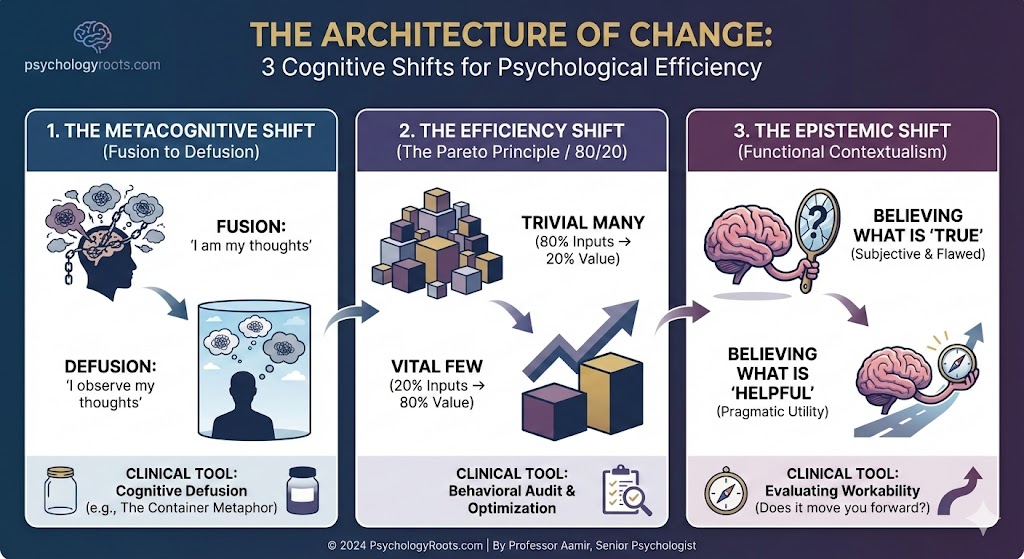
Manson describes the “Thinking Mind” (the generator of chatter) and the “Observing Mind” (the silent watcher). In academic psychology, this distinction is fundamental to Third-Wave Cognitive Behavioral Therapies, particularly ACT. We refer to this not merely as “two minds,” but as the distinction between Self-as-Content and Self-as-Context.
The Mechanism of Cognitive Fusion
Most psychological distress arises from “Cognitive Fusion”—a state where a person becomes entangled with their thoughts, treating them as absolute truths rather than transient mental events. When you are fused, a thought like “I am incompetent” is experienced as a fact.
The “Observing Mind” represents Self-as-Context—the stable perspective from which we observe our internal experiences without being defined by them. Research indicates that cultivating this “observer” stance reduces the believability of negative thoughts without needing to argue with them.
Clinical Application: Cognitive Defusion Techniques
To activate the Observing Mind, we use Cognitive Defusion techniques designed to separate the thinker from the thought:
- Verbal Repetition: Rapidly repeating a distressing word (e.g., “Failure”) for 30 seconds until it loses its semantic meaning and becomes just sound.
- Objectification: “Thanking” the mind for a negative thought (e.g., “Thank you, Mind, for that worry about the deadline”). This linguistic shift recontextualizes the thought as a suggestion rather than a command.
- The Container Metaphor: Viewing the self as the sky (context) and thoughts as weather (content). The weather changes, but the sky remains unharmed.
Critical Note: The goal is not to silence the Thinking Mind (which is impossible) but to uncouple from it. As research shows, suppression of thought often leads to a “rebound effect,” making the thoughts stronger.
II. The Efficiency Shift: The Behavioral Economics of Lifestyle
(The 80/20 Principle)
The Pareto Principle, or the 80/20 rule, posits that 80% of effects come from 20% of causes. While originally an economic theory, its application in Behavioral Psychology is profound. It relates to the concept of Response Effort and Reinforcement Schedules. Humans have limited cognitive resources; therefore, allocating them efficiently is a prerequisite for psychological well-being.
Optimization of Psychosocial Inputs
We can analyze our life through a behavioral audit:
- Social Connectivity: Analysis often reveals that a small fraction of social interactions (the “Vital Few”) provides the majority of emotional sustenance.
- Stimulus Control: Identify the 20% of environmental triggers (e.g., specific apps, messy environments) that cause 80% of your distraction or stress.
Strategic Reduction
Manson suggests identifying the “trivial many”—the 80% of activities that contribute only 20% to your fulfillment—and ruthlessly minimizing them. In therapy, this mirrors Behavioral Activation, where we schedule high-yield activities that align with values, rather than low-yield avoidance behaviors.
The Audit Protocol:
- List your weekly activities.
- Rate them by “Fulfillment Return on Investment” (FROI).
- Eliminate or delegate the bottom 80% of low-yield tasks to free up cognitive bandwidth for high-impact behaviors.
III. The Epistemic Shift: Functional Contextualism
(Believing What is Helpful, Not Just What is True)
The final concept challenges the obsession with “objective truth.” Manson argues that since our perceptions are flawed (subject to Confirmation Bias and memory errors), we should choose beliefs based on their utility.
The Science of Subjectivity
Psychologist Daniel Kahneman’s research on the “Remembering Self” vs. the “Experiencing Self” demonstrates that human memory is reconstructive and highly unreliable. Furthermore, Confirmation Bias ensures that we unconsciously filter for evidence that supports our pre-existing beliefs, whether they are adaptive or maladaptive.
Pragmatic Truth in Therapy
In Cognitive Behavioral Therapy (CBT), we often move beyond “Is this thought true?” to “Is this thought helpful?”. This aligns with the philosophical core of ACT, known as Functional Contextualism. In this framework, the “truth” of a thought is measured by its workability—does holding this belief help you move toward the life you want?
- Maladaptive Belief: “I am socially awkward.” (May be historically “true,” but holding it leads to isolation).
- Adaptive Belief: “I am learning to connect with others.” (Functionally useful; encourages approach behavior) .
Clinical Reframe: Instead of debating the validity of your insecurity, ask: “Does buying into this belief improve my functioning?” If the answer is no, you are authorized to adopt a more pragmatic belief, even if it feels “less real” initially.
IV. Conclusion: Integration into Practice
The transition from a “layperson” understanding of psychology to a professional one involves moving from passive experience to active regulation. The three ideas outlined—Cognitive Defusion, Behavioral Efficiency, and Epistemic Pragmatism—are not magic bullets. They are skills that require repetition.
By observing the mind rather than being it, optimizing your behavioral inputs, and selecting beliefs based on utility, you build a psychological architecture capable of withstanding stress and fostering growth.
Would you like me to develop a specific “Behavioral Audit” worksheet to help you apply the 80/20 principle to your daily routine?
References
- Blackledge, J. T. (2007). Disrupting verbal processes: Cognitive defusion in acceptance and commitment therapy. The Psychological Record, 57(4), 555-576.
- Hayes, S. C., Strosahl, K. D., & Wilson, K. G. (2012). Acceptance and commitment therapy: The process and practice of mindful change (2nd ed.). Guilford Press.
- Kahneman, D. (2011). Thinking, fast and slow. Farrar, Straus and Giroux.
- Manson, M. (2017). 3 Ideas That Can Change Your Life. MarkManson.net.
- Nickerson, R. S. (1998). Confirmation bias: A ubiquitous phenomenon in many guises. Review of General Psychology, 2(2), 175-220.
- Tversky, A., & Kahneman, D. (1974). Judgment under uncertainty: Heuristics and biases. Science, 185(4157), 1124-1131.
- Vilfredo, P. (1896). Cours d’économie politique. Rouge.
