 Psychology Roots
Table of Contents
The Triad of Recovery: Self-Control, Self-Efficacy, and Resilience in Substance Use Disorders
In the landscape of clinical psychology, few challenges are as pervasive or destructive as Substance Use Disorders (SUD). In Pakistan, the crisis is particularly acute; reports from the UNODC and local health bodies indicate that millions suffer from dependency, with opioids and synthetic drugs ravaging communities from the urban centers of Faisalabad to rural peripheries. But what separates those who succumb to addiction from those who maintain recovery?
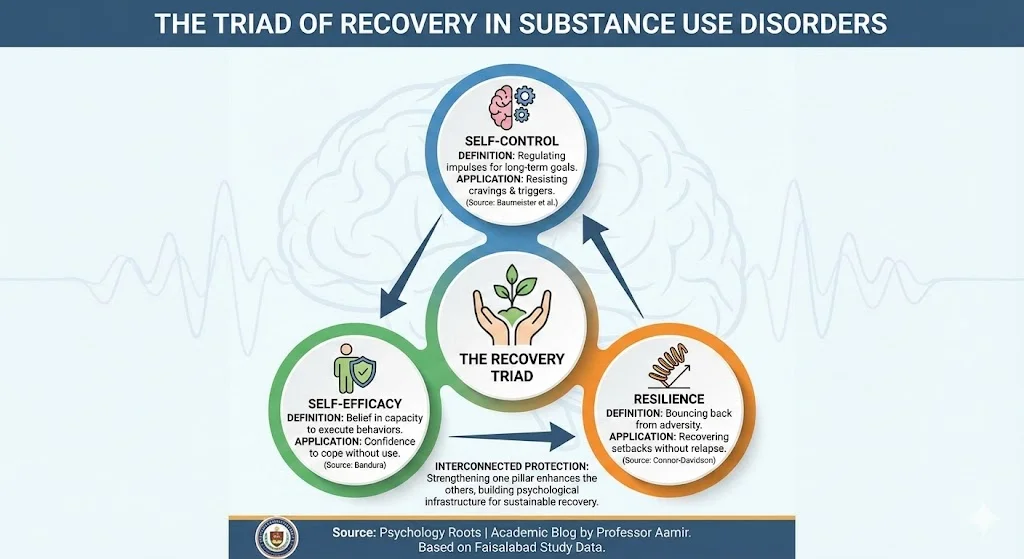
The answer often lies in three psychological pillars: Self-Control, Self-Efficacy, and Resilience.
As researchers and clinicians, we must move beyond viewing addiction solely as a biological dependence. We must understand the cognitive and behavioral mechanisms that enable an individual to resist a craving, believe in their capacity to change, and bounce back from inevitable setbacks. This analysis explores a recent cross-sectional study conducted in the Faisalabad division, offering critical insights into how these three variables interact within the local population.
Defining the Core Constructs
To understand the findings, we must first operationalize our variables through the lens of established psychological theory.
- Self-Control: Rooted in the work of Baumeister and the criminological theories of Gottfredson and Hirschi, self-control is the capacity to override immediate impulses (the “hot” system) in favor of long-term goals (the “cool” system). In the context of SUD, it is the mechanism that stops a hand from reaching for a substance.
- Self-Efficacy: A concept pioneered by Albert Bandura, this refers to an individual’s belief in their capability to execute behaviors necessary to produce specific performance attainments. For an addict, “abstinence self-efficacy” is the belief: “I can survive this stressor without using drugs.”
- Resilience: Often defined by Connor and Davidson, resilience is not merely surviving adversity but “bouncing back” to a state of normal functioning. It is the psychological elasticity that prevents a single lapse from becoming a full-blown relapse.
The Faisalabad Study: Methodology and Scope
A recent investigation targeting the Faisalabad division examined these variables among 200 participants (N=200). The sample was diverse, comprising adolescents and adults from rehabilitation centers, hospitals, and educational institutions.
Demographic Breakdown:
- Gender: 81.5% Male, 18.5% Female.
- Setting: 60% Urban, 40% Rural.
- Socioeconomic Status: A balanced mix of low (40%), middle (41%), and high (19%) income backgrounds.
The study utilized psychometrically valid instruments, including the Brief Self-Control Scale (BSCS), the General Self-Efficacy Scale (GSES), and the Connor-Davidson Resilience Scale (CD-RISC), ensuring the reliability of the data collected.
Key Findings and Critical Analysis
The data reveals compelling patterns that align with and occasionally diverge from global literature. Here is a breakdown of the primary results:
1. The “Recovery Triad” is Highly Correlated
The study confirmed a significant positive correlation between all three variables.
- Self-Control and Self-Efficacy: (r = .600**)
- Self-Efficacy and Resilience: (r = .693**)
- Self-Control and Resilience: (r = .555**)
Clinical Implication: These traits do not exist in a vacuum. A patient with high self-control is statistically more likely to possess high self-efficacy and resilience. Therapeutic interventions that target one (e.g., building efficacy through small wins) will likely create a “spillover effect,” enhancing the patient’s overall psychological armor.
2. The Gender Paradox
One of the most striking findings in this specific sample was the gender difference.
- Self-Control: Males (M=43.00) scored significantly higher than Females (M=39.24).
- Self-Efficacy: Males (M=30.49) scored higher than Females (M=27.70).
- Resilience: Males (M=34.23) scored higher than Females (M=30.86).
Critical Analysis: While some global studies suggest women often possess higher internal regulation, this finding may reflect the specific sociocultural context of Pakistan. Women with SUDs in Pakistan often face “double stigma”—being judged for the addiction and for violating gender norms. This intense social marginalization may erode their self-efficacy and resilience compared to their male counterparts, who may have greater access to social support and rehabilitation resources.
3. Education as a Buffer
The data indicates that educational attainment serves as a protective factor. Participants with higher education levels (Master’s degree) demonstrated significantly higher mean scores in self-control and resilience compared to those with only Matriculation or Intermediate education.
This supports the cognitive reserve hypothesis, suggesting that the cognitive discipline required for higher education may strengthen the executive functions associated with self-control.
4. The Rural-Urban Divide (or Lack Thereof)
Interestingly, the study found no statistically significant disparity in resilience or self-efficacy between rural and urban residents. This suggests that the psychological toll of addiction is universal. Whether a patient is in a village in the Punjab periphery or the heart of Faisalabad city, the internal struggle against dependency remains consistent.
Clinical Recommendations
Based on this data, we can propose specific evidence-based interventions for mental health professionals working with SUD patients:
- Integrated CBT Approaches: Since self-efficacy and self-control are linked, Cognitive Behavioral Therapy (CBT) should focus on “mastery experiences.” Helping a patient successfully navigate a small trigger builds efficacy, which in turn strengthens self-control.
- Gender-Specific Support: The lower scores among female participants highlight an urgent need for gender-sensitive rehabilitation programs. These programs must address the unique shame and isolation women face, focusing on rebuilding their shattered self-concept.
- Resilience Training: We must treat resilience as a skill, not a trait. Techniques such as stress inoculation training can help patients view stressors as challenges to be overcome rather than insurmountable threats.
Conclusion
The battle against Substance Use Disorder is fought on the battlegrounds of the mind. This study from Faisalabad reinforces that recovery is not a matter of luck; it is a matter of psychological infrastructure. By strengthening the triad of self-control, self-efficacy, and resilience, we give patients the tools not just to survive addiction, but to thrive in recovery.
As we move forward, researchers and policymakers must focus on reducing the structural barriers particularly for women and those with lower education that prevent the development of these crucial psychological assets.
References
- Bandura, A. (1997). Self-efficacy: The exercise of control. W.H. Freeman.
- Baumeister, R. F., Vohs, K. D., & Tice, D. M. (2007). The strength model of self-control. Current Directions in Psychological Science, 16(6), 351–355.
- Connor, K. M., & Davidson, J. R. (2003). Development of a new resilience scale: The Connor-Davidson Resilience Scale (CD-RISC). Depression and Anxiety, 18(2), 76–82.
- Gottfredson, M. R., & Hirschi, T. (1990). A general theory of crime. Stanford University Press.
- Tangney, J. P., Baumeister, R. F., & Boone, A. L. (2004). High self-control predicts good adjustment, less pathology, better grades, and interpersonal success. Journal of Personality, 72(2), 271–324.
- UNODC. (2024). World Drug Report 2024. United Nations Office on Drugs and Crime.
