 Psychology Roots
Table of Contents
Adolescence, Depression, and the Buffer of Social Support: An Empirical Analysis
Adolescence is frequently characterized in psychological literature as a period of “storm and stress” a term coined by G. Stanley Hall to describe the volatile transition between childhood and adulthood. While modern psychology offers a more nuanced view, the reality remains that this developmental phase is a critical window for the onset of psychopathology, particularly depression.
According to recent epidemiological data, depression in adolescents is rising at an alarming rate, often exacerbated by academic pressure, identity formation crises, and fluctuating family dynamics. However, not all adolescents succumb to these pressures. Why do some teenagers navigate these turbulent years with resilience while others spiral into depressive states?
The answer often lies in Perceived Social Support (PSS).
In this article, we will analyze recent empirical data exploring the relationship between depression and social support among adolescents. Drawing from a study utilizing the Siddiqui-Shah Depression Scale (SSDS) and the Rafi Social Support Scale, we will examine how family structures, gender differences, and peer networks act as protective buffers against mental health decline.
The Theoretical Framework: The Buffering Hypothesis
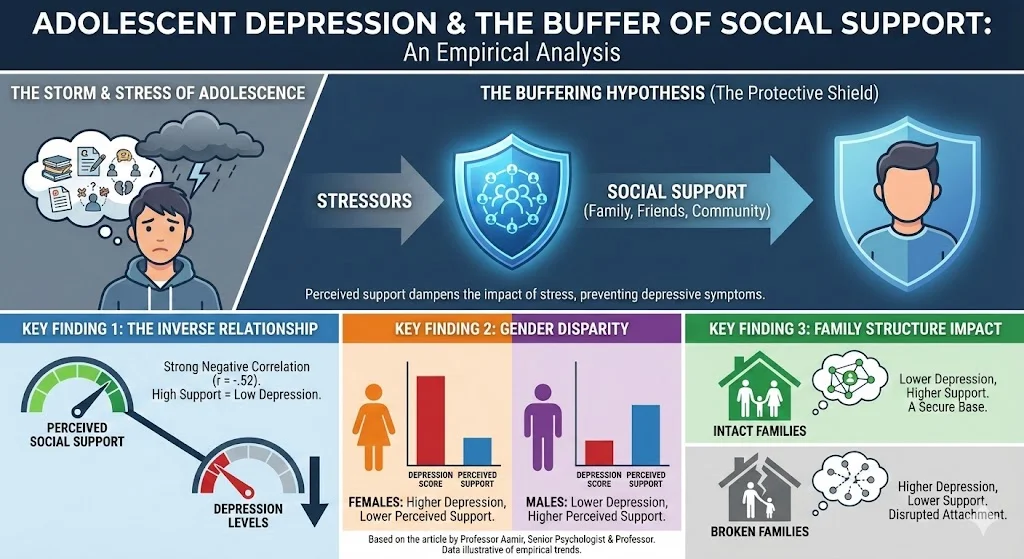
To understand the data, we must first ground ourselves in the Buffering Hypothesis proposed by Cohen and Wills (1985). This theory posits that social support protects (or “buffers”) individuals from the pathogenic effects of stressful events.
Social support operates through two primary mechanisms:
- Direct Effect: Being embedded in a social network provides a sense of purpose and belonging, which directly enhances mental well-being regardless of stress levels.
- Buffering Effect: When stress arises (e.g., academic failure, family conflict), perceived support intervenes between the stressor and the stress reaction, preventing the development of depressive symptoms.
Crucially, it is the perception of support—believing that help is available if needed—that often matters more than the actual receipt of help.
Empirical Evidence: The Inverse Relationship
A recent investigation involving 200 adolescents (ages 14–17) provides compelling evidence for this protective mechanism. The study revealed a significant negative correlation (r = -.52, p < .001) between total social support and depression levels.
Key Findings from the Data:
- High Support = Low Depression: Adolescents who scored higher on the Rafi Social Support Scale consistently demonstrated lower scores on the Siddiqui-Shah Depression Scale.
- The Power of Family: Among the sources of support (family, friends, significant others), family support showed the strongest negative correlation with depression ($r = -.27$). This suggests that in the cultural context of the study (likely Pakistan, given the instruments used), the family unit remains the primary psychological anchor.
Analysis: This data confirms that social isolation is a potent risk factor. When an adolescent perceives a lack of support, their cognitive appraisal of stressors becomes more negative, leading to the hopelessness characteristic of clinical depression (Beck, 1967).
The Gender Gap: Vulnerability in Female Adolescents
One of the most striking findings in this dataset is the disparity between genders. The analysis indicated that female adolescents scored significantly higher on depression measures compared to their male counterparts (t = 5.43, p < .001).
| Variable | Male Mean (M) | Female Mean (M) | Interpretation |
| Depression | 60.56 | 99.01 | Females reported drastically higher depressive symptoms. |
| Social Support | 94.54 | 74.11 | Males perceived significantly higher availability of support. |
Psychological Interpretation
Why this discrepancy?
- Rumination vs. Distraction: Research by Nolen-Hoeksema suggests that females are more prone to rumination (passively dwelling on distress), whereas males often engage in distraction (active coping).
- Socialization and Support Perception: Interestingly, while females often have wider social networks, the data here suggests they perceived less support than males. This could stem from higher interpersonal sensitivity—females may require higher thresholds of emotional validation to feel “supported” compared to males, who may be satisfied with instrumental support (e.g., shared activities).
- Pubertal Timing: The onset of puberty is a known biological trigger for depression in females, occurring alongside intensifying social pressures.
Family Structure: The Impact of “Broken” Homes
The study also categorized participants based on family structure: Intact Families (living with both parents) vs. Broken Families (divorce, separation, or death).
The results were unequivocal:
- Depression: Adolescents from broken families scored significantly higher (M = 99.01) than those from intact families (M = 62.45).
- Social Support: Conversely, perceived social support was significantly lower in the broken family group (t = 5.13, p < .001).
Contextualizing the Joint Family System
In many collective cultures, such as Pakistan, the Joint Family System serves as a built-in support network. When this structure fractures, the adolescent loses not just a parent, but often a wider web of cousins, aunts, and uncles who provide emotional scaffolding. The “broken family” variable here represents a profound disruption in the child’s “secure base,” leading to attachment anxieties that manifest as depression.
Critical Analysis & Clinical Implications
The findings of this study have direct implications for clinical practice and educational policy.
1. Screening for Perceived Isolation
Clinicians treating adolescents must move beyond asking “Do you have friends?” to asking “Do you feel supported?” The distinction is vital. An adolescent can be popular yet feel profoundly isolated.
2. Targeted Interventions for Girls
Given the 2:1 ratio of female-to-male depression often cited in literature and supported by this data, schools should implement preventive programs focusing on cognitive restructuring and emotional regulation specifically for female students.
3. Family Therapy as a Necessity
For adolescents from broken families, individual therapy is often insufficient. Family therapy is required to repair the “support systems.” Even if parents are separated, establishing a co-parenting alliance can restore the adolescent’s sense of security.
Conclusion
The data is clear: Social support is not merely a social luxury; it is a psychological necessity. It acts as a shield, dampening the impact of life’s stressors before they can evolve into clinical depression. For the adolescent navigating the treacherous waters of identity and independence, knowing there is a safe harbor—whether in a parent, a teacher, or a friend—can make the difference between resilience and despair.
References
- Beck, A. T. (1967). Depression: Clinical, experimental, and theoretical aspects. University of Pennsylvania Press.
- Cohen, S., & Wills, T. A. (1985). Stress, social support, and the buffering hypothesis. Psychological Bulletin, 98(2), 310–357.
- Galambos, N. L., Leadbeater, B. J., & Barker, E. T. (2004). Gender differences in and risk factors for depression in adolescence: A 4-year longitudinal study. International Journal of Behavioral Development, 28(1), 16–25.
- Nolen-Hoeksema, S. (2001). Gender differences in depression. Current Directions in Psychological Science, 10(5), 173-176.
- Procidano, M. E., & Heller, K. (1983). Measures of perceived social support from friends and from family: Three validation studies. American Journal of Community Psychology, 11(1), 1-24.
- Rafi, M. (1991). The development of a Social Support Scale for Pakistani population. (Unpublished master’s thesis). National Institute of Psychology, Quaid-i-Azam University, Islamabad.
- Siddiqui, S., & Shah, S. A. (1997). Siddiqui-Shah Depression Scale (SSDS): Development and validation. Psychology and Developing Societies, 9(2), 245-262.
