 Psychology Roots
Table of Contents
Is Your Brain Lying to You? The Psychology of Perception and Reality
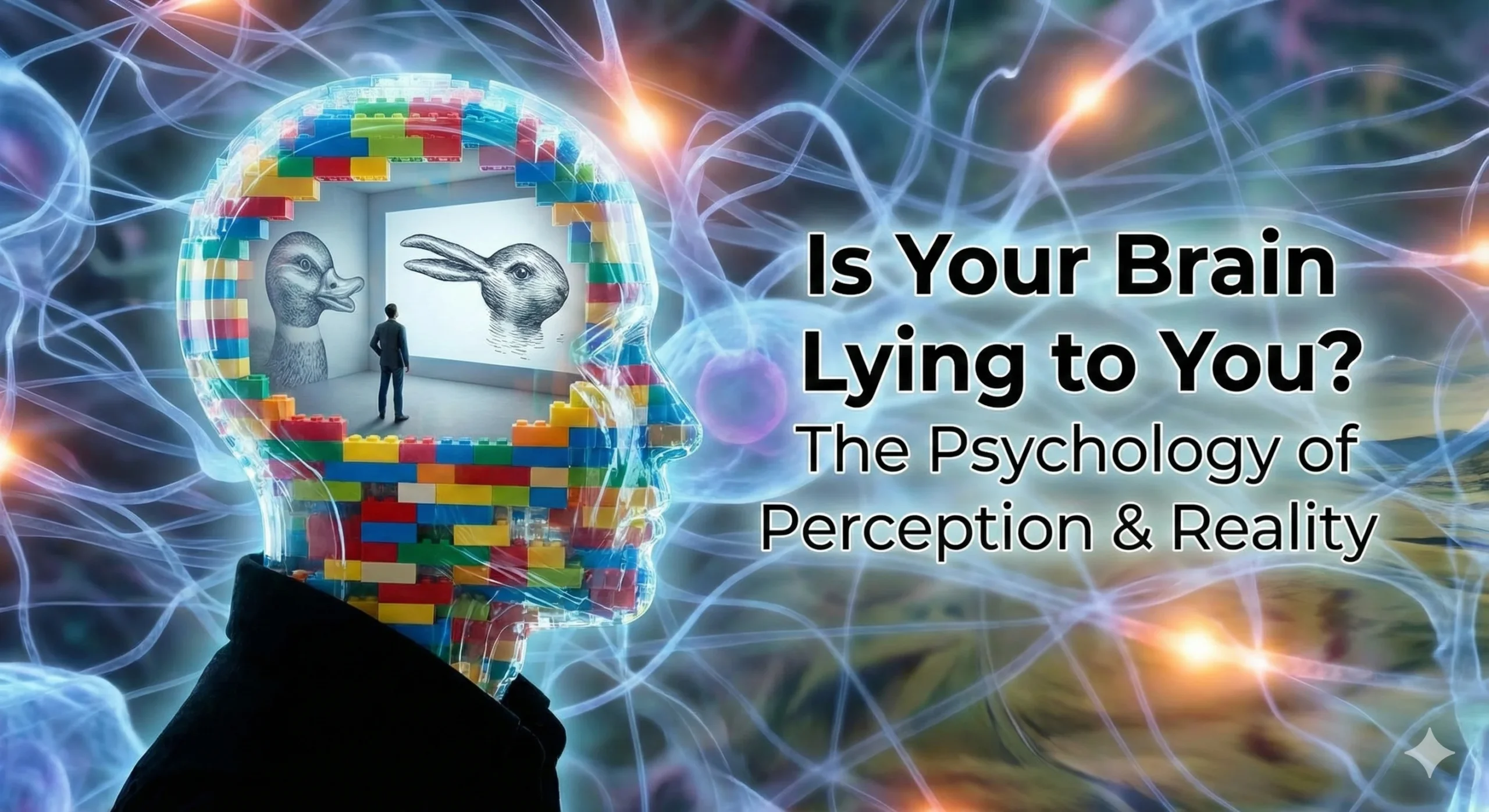
Have you ever stared at a cloud and sworn it looked exactly like a dog, while your friend insisted it looked like a hamburger? Or perhaps you’ve looked at an optical illusion—like the famous “is it a duck or a bunny?” drawing—and felt your brain flip-flop between two completely different images?
It’s a disorienting feeling, but it reveals a fundamental truth about human psychology: We do not see the world exactly as it is. We see the world as we are.
As a psychologist, I often remind clients that our eyes are merely biological cameras capturing raw data. It is the brain—with all its biases, memories, and expectations—that acts as the editor, cutting and splicing that footage into what we call “reality.” This process is the difference between sensation and perception, and understanding it can fundamentally change how you navigate your daily life.
Sensation vs. Perception: The Lego Metaphor
To understand how our minds work, we first have to distinguish between two distinct processes that happen almost simultaneously.
- Sensation: This is the “bottom-up” processing. It’s your sensory receptors (eyes, ears, nose) detecting stimuli. It is the raw data—light waves, sound vibrations, chemical compounds.
- Perception: This is the “top-down” processing. It is how your brain organizes, interprets, and consciously experiences that data.
Think of it this way: Sensation is like a child dumping a bucket of Legos onto the floor. Perception is what you build with those Legos. The raw materials (the bricks) are the same for everyone, but the structure you build—a castle, a car, or a chaotic tower—is entirely unique to your mind.
Without perception, your mother’s face would just be a geometry equation of light and shadow. Without perception, the smell of morning coffee would be indistinguishable from a grease fire. Perception is the magic that makes life meaningful, but it also means our reality is subjective.
The Perceptual Set: Why Believing is Seeing
We’ve all heard the phrase “seeing is believing,” but in psychology, the reverse is often true: Believing is seeing.
Your brain is a prediction machine. To save energy, it uses “shortcuts” based on your past experiences, expectations, cultural background, and even your current mood. We call this your Perceptual Set.
The Influence of Context and Emotion
If I showed you an ambiguous image that looked like a circle with two long loops, and I primed you by talking about Easter, you would likely see a bunny. If I primed you by talking about a pond, you’d see a duck. Your brain projects your expectation onto the image before you’ve even fully processed it.
This phenomenon extends beyond visual tricks and into our emotional reality. Research has shown that our physical state influences our perception of the environment.
- The Hill Study: People listening to sad, melancholic music tend to perceive a hill as steeper than those listening to upbeat, energetic music.
- The Social Factor: That same hill looks less steep if you are standing next to a friend than if you are standing alone.
This is a powerful insight for mental health. If the world feels “impossible” or “too steep” right now, it might not be the mountain that has changed, but your internal perceptual set.
Chaos to Order: How We Organize the World
Imagine you are at a crowded party. The music is loud, dozens of people are talking, and glasses are clinking. Yet, you are able to focus entirely on the voice of your crush standing five feet away.
How does your brain filter out the “cacophonous chaos” to focus on that one signal? This is known as Form Perception, and we rely on specific rules to make it happen.
The Figure-Ground Relationship
The most basic organizational tool our brain uses is separating the “figure” (the object of focus) from the “ground” (the background). In the party scenario, your crush’s voice becomes the figure, and the rest of the chatter fades into the ground.
Interestingly, this relationship is reversible. If someone yells your name from across the room, your attention shifts. Suddenly, your crush’s voice becomes the background, and the new voice becomes the figure. This ability to switch focus is vital for survival (and social awkwardness).
The Gestalt Rules of Grouping
Our brains are desperate for order. When we look at a scene, we don’t see random dots or shapes; we group them into wholes. This is the foundation of Gestalt Psychology.
- Proximity: We group things that are close together. At that party, if three people are standing near the snack table, you assume they are a group, even if they are strangers.
- Closure: Our brains hate gaps. If you see a circle with a small piece missing, your brain automatically “fills in” the missing line to perceive a complete circle. We do this in relationships, too—often filling in the blanks of a partner’s behavior with our own assumptions (for better or worse).
- Continuity: We prefer to see smooth, continuous patterns rather than broken ones.
Depth Perception: Navigating a 3D World
One of the greatest marvels of the human mind is Depth Perception. The image that hits your retina is actually two-dimensional (flat). Yet, we perceive the world in glorious 3D.
We achieve this through two types of cues:
- Binocular Cues: Since our eyes are about 2.5 inches apart, each eye captures a slightly different image. The brain compares these two images (retinal disparity) to calculate distance. It’s why you can’t catch a ball easily with one eye closed.
- Monocular Cues: For things far away, we rely on cues like Linear Perspective (parallel lines, like railroad tracks, seem to converge in the distance) and Interposition (if one object blocks another, we know it’s closer).
We also rely on Perceptual Constancy. This is the ability to recognize that an object remains the same even if the lighting or angle changes. When a car drives away from you, the image on your retina gets smaller, but your brain knows the car isn’t actually shrinking—it’s just moving further away.
The Takeaway: You Construct Your Reality
Why does any of this matter outside of a psychology classroom?
Because understanding perception empowers you. It teaches us that our initial reaction to a situation—an odd look from a boss, a text message that seems cold, a news headline—is a construction of our mind, not necessarily the objective truth.
Just like the “duck or bunny” illusion, we often have the power to flip the script. We can challenge our perceptual sets. We can ask ourselves: Am I seeing this situation as a threat because it is one, or because my “background music” is currently sad?
Your brain is a master architect, building your world one Lego brick at a time. The beautiful thing about Legos? You can always break them down and build something new.
Reflection Questions
- Can you think of a recent disagreement you had where you and the other person simply had different “Perceptual Sets”?
- How might your current mood be influencing how “steep” your daily challenges look today?
Help Us Improve This Article
Have you discovered an inaccuracy? We put out great effort to give accurate and scientifically trustworthy information to our readers. Please notify us if you discover any typographical or grammatical errors.
Make a comment. We acknowledge and appreciate your efforts.
Share With Us
If you have any scale or any material related to psychology kindly share it with us at [email protected]. We help others on behalf of you.
