 Psychology Roots
Table of Contents
Alexithymia: The Silence of the Self and Clinical Implications of Emotional Blindness
In contemporary clinical psychology, we observe a rising prevalence of individuals struggling with emotional dysregulation, often manifesting as depression or anxiety. However, a subset of this population faces a more fundamental deficit: the inability to conceptualize their internal states as emotional problems due to a lack of awareness.
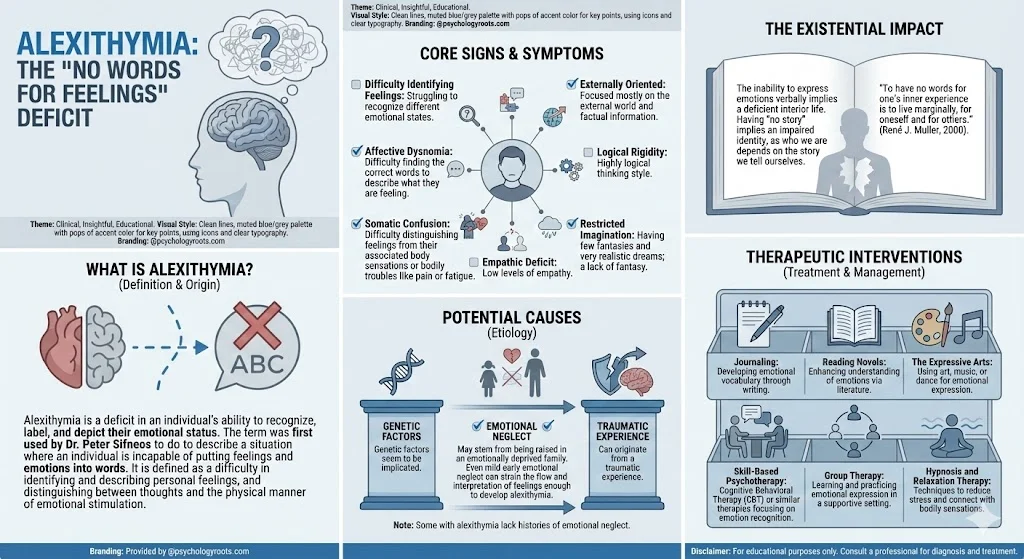
This condition is known as alexithymia. Defined as a deficit in an individual’s ability to recognize, label, and depict their emotional status, alexithymia represents a significant barrier to psychological well-being. The term was originally coined by Dr. Peter Sifneos to describe patients who were incapable of articulating their feelings and emotions into words. It is not merely a denial of emotion but a specific disturbance in affective processing where the individual cannot distinguish between emotional states and somatic sensations.
Clinical Phenomenology and Signs
The symptomatology of alexithymia is distinct from simple repression or suppression. Nemiah, Freyberger, and Sifneos (1977) established the core characteristics that define the construct. Clinically, we observe a marked difficulty in identifying and describing personal feelings. This often presents as a limited understanding of the events or stimuli that trigger emotional responses.
The attributes of individuals presenting with alexithymia include the following:
- Affective Dysnomia: A persistent difficulty in finding the correct words to describe internal states.
- Somatic Confusion: A struggle to distinguish feelings from the associated bodily sensations of emotional arousal.
- Constricted Imaginal Processes: A restriction in imagination, characterized by a lack of fantasy and dreams that are strictly realistic rather than symbolic.
- Externally Oriented Thinking: A cognitive style focused predominantly on the external world and factual information rather than internal experience.
- Logical Rigidity: A reliance on highly logical thinking to the detriment of emotional nuance.
- Empathic Deficits: Low levels of empathy, likely stemming from the inability to model the emotional states of others.
While these individuals may experience disturbing physiological responses and remain conscious of a reaction, they encounter profound difficulty in categorizing the specific emotion they are experiencing.
Etiology: Developmental and Neurobiological Perspectives
The origins of alexithymia are multifactorial. While genetic factors are implicated, the condition often stems from environmental variables, such as being raised in an emotionally deprived family, excessive regimentation, or traumatic experiences.
The Role of Early Attachment
Research highlights the impact of early emotional neglect. Alexithymia may originate from neglect that is too mild to cause overt psychological disorders yet sufficient to strain the flow and interpretation of feelings required for emotional development. In 2012, Sabine Aust examined the role of early attachment and emotional regulation, assessing early life stress and emotional functioning. While the study confirmed that alexithymic individuals with histories of emotional neglect could appear physically healthy , it also noted that some individuals with alexithymia lack any history of neglect. This suggests distinct pathways to the disorder: likely a differentiation between “primary” (trait) alexithymia and “secondary” (state) alexithymia resulting from trauma.
Psychosomatic and Existential Implications
The clinical presentation of alexithymia often involves somatization. Because these individuals cannot process emotional signals cognitively, they frequently experience emotional responses as bodily troubles, such as pain or fatigue.
Furthermore, the condition has profound existential consequences. A narrative identity, the story we tell ourselves about who we are, is essential for psychological stability. If a patient has “no story” to tell a clinician, even during high-stress events like an emergency room visit, it indicates they likely possess no internal narrative for themselves. This inability to express emotions verbally implies a deficient interior life. As noted by René J. Muller (2000), to lack words for one’s inner experience is to live marginally, both for oneself and in contact with others.
Therapeutic Interventions
Treating alexithymia requires specialized approaches that bypass standard talk therapy, which relies on the very verbal skills these patients lack. Effective treatment modalities focus on building emotional literacy and somatic awareness.
Current therapeutic strategies include:
- The Expressive Arts: Utilizing non-verbal mediums to access emotional content.
- Journaling: Encouraging the cognitive structuring of daily experiences to bridge the gap between event and feeling.
- Bibliotherapy: Reading novels to enhance theory of mind and vocabulary for complex emotional states.
- Skill-based Psychotherapy: Structured approaches such as CBT or DBT to teach emotion identification.
- Group Therapy: Providing a social laboratory to observe and model emotional communication.
- Somatic Regulation: Hypnosis and relaxation therapy to address the physiological dysregulation associated with the condition.
Conclusion
Alexithymia is more than a personality quirk; it is a significant defect in cognitive style and emotional processing. By understanding the specific deficits, ranging from limited imagination to somatic confusion, clinicians can better tailor interventions. Recognizing that these individuals live with a “deficient interior life” allows for a more compassionate and effective therapeutic alliance, moving the patient from a factual existence toward one of emotional richness.
References
- Aust, S. (2012). The role of early attachment and emotional regulation in alexithymia.
- Laura, K. (2010). Empathy and Alexithymia.
- Muller, R. J. (2000). The marginal self: An existential inquiry.
- Nemiah, J. C., Freyberger, H., & Sifneos, P. E. (1977). Alexithymia: A view of the psychosomatic process.
- Salters, K. (2009). Somatization and Alexithymia.
