 Psychology Roots
Table of Contents
The Termination Thesis: Do We Cease to Exist When We Die?
In the field of existential psychology and thanatology, few concepts instigate as much primal anxiety as the fear of annihilation. The belief that death marks the absolute end of existence, that we simply “snuff out” like a candle, is a pervasive assumption in Western thought. In philosophy, this view is known as the Termination Thesis (TT).
While this may seem intuitively correct, close metaphysical analysis suggests otherwise. Drawing on the work of philosopher Fred Feldman, this article challenges the Termination Thesis, exploring the distinction between ceasing to exist as a person versus ceasing to exist simpliciter. For psychologists, understanding this distinction is more than an academic exercise; it reframes our conceptualization of mortality, identity, and the material continuity of the self.
1. Defining the Termination Thesis
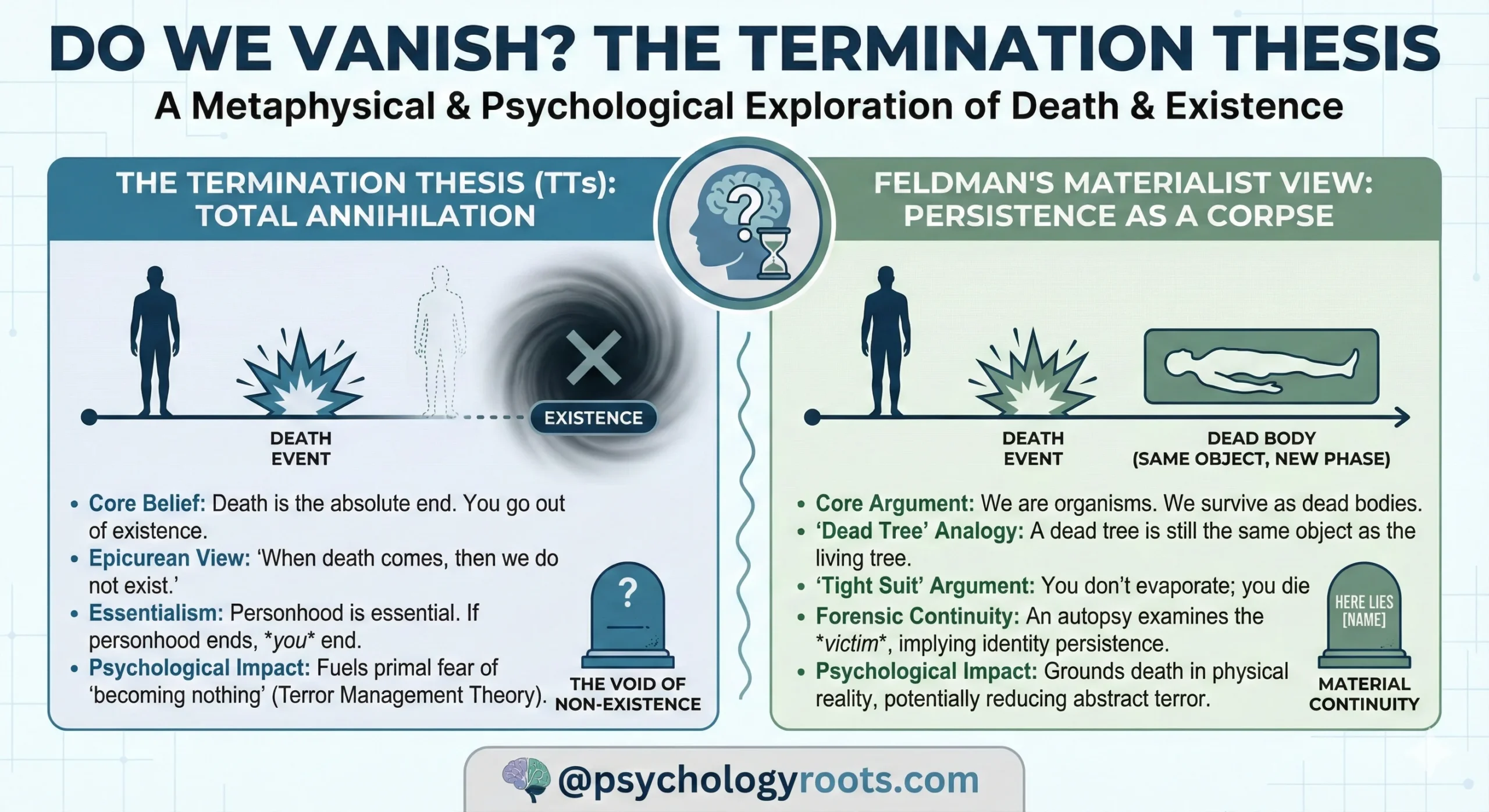
The Termination Thesis (TT) is the doctrine that people go out of existence when they die. This view has deep historical roots. Epicurus, the ancient Greek philosopher, famously argued that it is irrational to fear death because “when death comes, then we do not exist”. Lucretius echoed this, claiming that death creates a separation of body and soul so complete that “nothing whatever can happen to excite sensation” because we are “no more”.
In modern philosophy, this view remains dominant. Thinkers like L.W. Sumner and Jay Rosenberg have argued that the death of a person is the end of that person; to die is to cease to exist. However, this “common sense” position faces rigorous logical challenges when we examine the material reality of death.
The Two Types of Termination
To dismantle the TT, we must first distinguish between two interpretations of what it means to “cease to exist”:
- Termination Thesis (Simpliciter) – TTs: When a person dies, they simply go out of existence entirely. The object that was them is gone.
- Termination Thesis (Personhood) – TTp: When a person dies, they cease to exist as a person (they lose agency, consciousness, and personality), but the entity may continue to exist as something else (e.g., a corpse).
Feldman argues that while TTp is undeniably true (we do stop being “persons” with rights and consciousness), TTs is false. We do not vanish; we persist as dead bodies.
2. Arguments Against the Termination Thesis
If we accept the materialist view—that we are our bodies—then the Termination Thesis (TTs) becomes difficult to defend. Feldman presents several compelling arguments to show that we survive our deaths, albeit in a radically altered state.
A. The “Dead Tree” Analogy
Consider a huge old elm tree in a field that has been dead for years. We can point to it and say, “That tree is fifty years old.” We do not say, “That object came into existence when the tree died”. We recognize that the living tree and the dead tree are the same persistent object.
If we admit that organisms like trees do not go out of existence when they die, why do we treat humans differently?. If people are biological organisms, the transition from “alive” to “dead” is a change in a persisting object, not the annihilation of that object.
B. The “Here Lies” Argument
Walk through any graveyard, and you will see inscriptions like “Here lies John Smith.” If the Termination Thesis were true, these inscriptions would be lies. If John Smith ceased to exist the moment he died, he cannot be “lying” in the grave.
The linguistic intuition here is strong: we refer to the corpse as the person. We say, “He looks peaceful,” or “She is being buried.” These sentences presuppose that the subject (“He” or “She”) still exists to be buried or to look peaceful.
C. The “Tight Suit” Argument
Feldman offers a vivid reductio ad absurdum involving a person who dies wearing a tight-fitting suit. If the Termination Thesis is true, the person vanishes at death, and a new object (the corpse) instantly pops into existence.
If so, how did the corpse get inside the suit? The zippers were not undone; the buttons were not unfastened. It is logically absurd to suggest the person evaporated and a corpse materialized inside the clothing. It is far more reasonable to conclude that the person died in the suit and remains in the suit as a dead body.
D. The Forensic Argument
When a medical examiner performs an autopsy to determine a cause of death, they are examining the victim. Imagine finding a bullet lodged in a skeleton and saying, “This bullet struck him twenty years ago”.
This statement implies identity continuity. The object on the table is the same object that was shot twenty years ago. If the person had ceased to exist at death, the examiner would be performing an autopsy on a totally new, unrelated object that never suffered a gunshot wound.
3. The Counter-Arguments: Why Do We Believe We Vanish?
If the evidence for our continued material existence is so strong, why does the Termination Thesis persist? Proponents of TT often rely on arguments regarding Essential Properties.
The argument typically goes like this:
- Being a “person” requires certain essential traits (rationality, self-consciousness, a first-person perspective).
- Death destroys these traits.
- Therefore, death destroys the person.
The Flaw in Essentialism
This argument begs the question. It assumes that “being a person” is an essential property of the object, rather than a phase property (like being a “student” or a “virgin”). When a student graduates, they cease to be a student, but they do not go out of existence. Similarly, when a human dies, they may cease to be a “person” (in the psychological sense), but the organism persists.
Feldman notes that even living people can lose these “essential” traits without ceasing to exist. A person in a deep coma may lose their first-person perspective or rationality, yet we still regard them as the same entity—we pay their medical bills and visit them. If we can exist comatose, we can exist dead.
4. Critical Analysis: Psychological Implications
As psychologists, we must ask: Does this metaphysical distinction matter?
Yes. It fundamentally alters the cognitive landscape of death anxiety. Terror Management Theory (TMT) posits that much of human behavior is driven by the fear of mortality—specifically, the fear of becoming nothing. The Termination Thesis fuels this fear by equating death with total annihilation.
Feldman’s materialist rejection of TT offers a grounded, albeit somber, alternative: We do not vanish. We transform. We are biological organisms that undergo a phase change from “living” to “dead.” This aligns with the “Animalist” view in metaphysics, which holds that we are fundamentally human animals. While our psychological life ends, our physical history continues.
In clinical settings, this perspective can be useful for clients struggling with the abstract horror of “non-existence.” Grounding death in physical reality (the corpse, the remains, the memory) can sometimes be less terrifying than the abstract void of Epicurean non-existence. It acknowledges that we remain part of the material world, even when our agency is gone.
Conclusion
The Termination Thesis—the idea that we go out of existence when we die—rests on a confusion between our social identity (Personhood) and our material identity (the Organism). While we undeniably cease to be psychological agents at death, the arguments from biology, language, and logic suggest we persist as physical objects.
We are our bodies. We grow, we live, we die, and we remain. As Feldman concludes, “You can’t get rid of me so easily”. We may become dead people, but we are people nonetheless.
References
- Epicurus. (1940). Letter to Menoeceus. In W. J. Oates (Ed.), The Stoic and Epicurean Philosophers. Random House.
- Feldman, F. (1992). Confrontations with the Reaper: A Philosophical Study of the Nature and Value of Death. Oxford University Press.
- Feldman, F. (2000). The Termination Thesis. Midwest Studies in Philosophy, 24, 98-115.
- Lucretius. (1940). On the Nature of Things. In W. J. Oates (Ed.), The Stoic and Epicurean Philosophers. Random House.
- Olson, E. (1997). The Human Animal. Oxford University Press.
- Rosenberg, J. (1983). Thinking Clearly about Death. Prentice-Hall.
- Sumner, L. W. (1976). A Matter of Life and Death. Noûs, 10(2), 145-171.
